
ATLANTA, Georgia — July 28, 2026. DDM Systems announced that its LAMP™ ceramic 3D-printing platform is positioned to address a production constraint behind the expansion of gas-turbine power for AI data centers: the long lead time for precision-cast hot-section components.
The announcement follows a sharp increase in demand for gas-turbine capacity as hyperscalers plan dedicated and behind-the-meter power generation. Turbine manufacturers can expand final assembly, but every additional unit still depends on blades, vanes and nozzle guide vanes made from high-temperature superalloys. The ceramic shells and cores used to cast those parts remain a critical part of the production path.
The constraint is upstream of final assembly
Advanced gas-turbine components operate in severe thermal environments and often contain complex internal cooling passages. Conventional investment casting typically requires dedicated dies, wax patterns, injected ceramic cores, core assembly and repeated shell-building steps before metal can be poured. Tooling and shell preparation can therefore consume months before a foundry produces the first acceptable casting.
DDM Systems developed LAMP—Large Area Maskless Photopolymerization—to replace that tooling-intensive front end with direct production of ceramic investment-casting shells and integrated cores from CAD data. The production-scale platform uses patterned ultraviolet light to cure ceramic slurry layer by layer across a 24 × 24 × 24-inch build volume.
The resulting workflow removes seven of the twelve steps in the conventional process and eliminates wax-pattern tooling. It also allows shell and core geometries to be produced as a coordinated digital design rather than as separately tooled components.
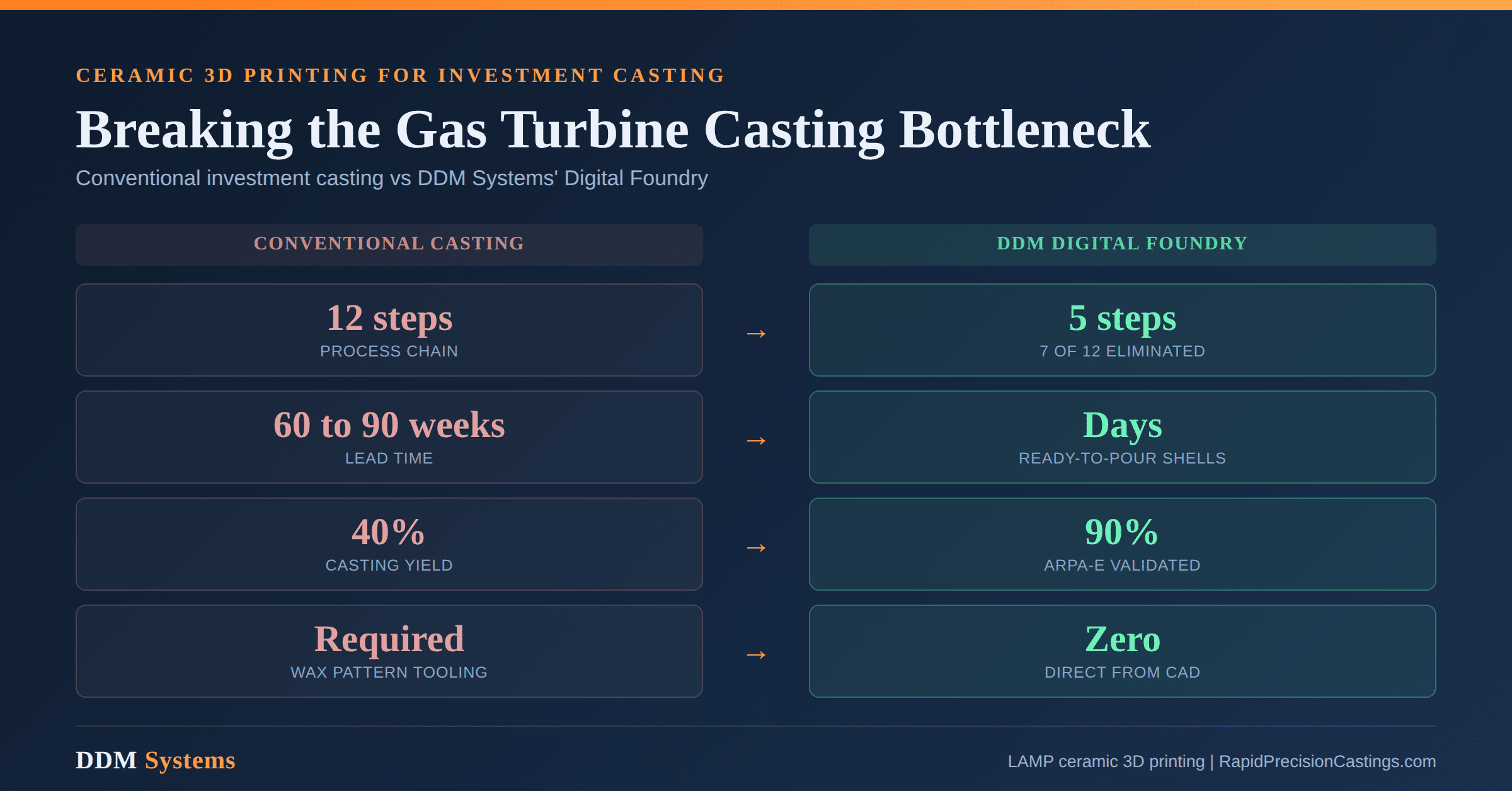
“We can produce ready-to-pour ceramic shells in days that would take conventional methods months to tool and build.”
Dr. Suman Das, Founder, President and CEO, DDM Systems
From ceramic shell to finished casting
LAMP is the ceramic-manufacturing layer within DDM Systems’ broader Digital Foundry. Through tooling-free investment casting services and the DirectPour™ process, customers can submit a CAD model and alloy requirement and receive finished castings. DDM coordinates shell design, ceramic printing, thermal processing and foundry operations.
DirectPour is an end-to-end casting service where customers submit a CAD file and receive finished castings in their specified alloy, with DDM handling shell design, 3D printing, thermal processing and coordination with foundry partners. The Digital Foundry compresses the casting timeline from months to days while maintaining the metallurgical quality turbine OEMs require.
DDM has demonstrated casting work in vacuum-melt nickel superalloys used in turbine and aerospace applications, including CMSX-4, IN 718, IN 713C, IN 738LC, René alloys, MAR-M247 and IN100. The company’s turbine-blade manufacturing and repair capabilities also include SLE™ scanning laser epitaxy for single-crystal, directionally solidified and equiaxed structures.
Documented federal research and development
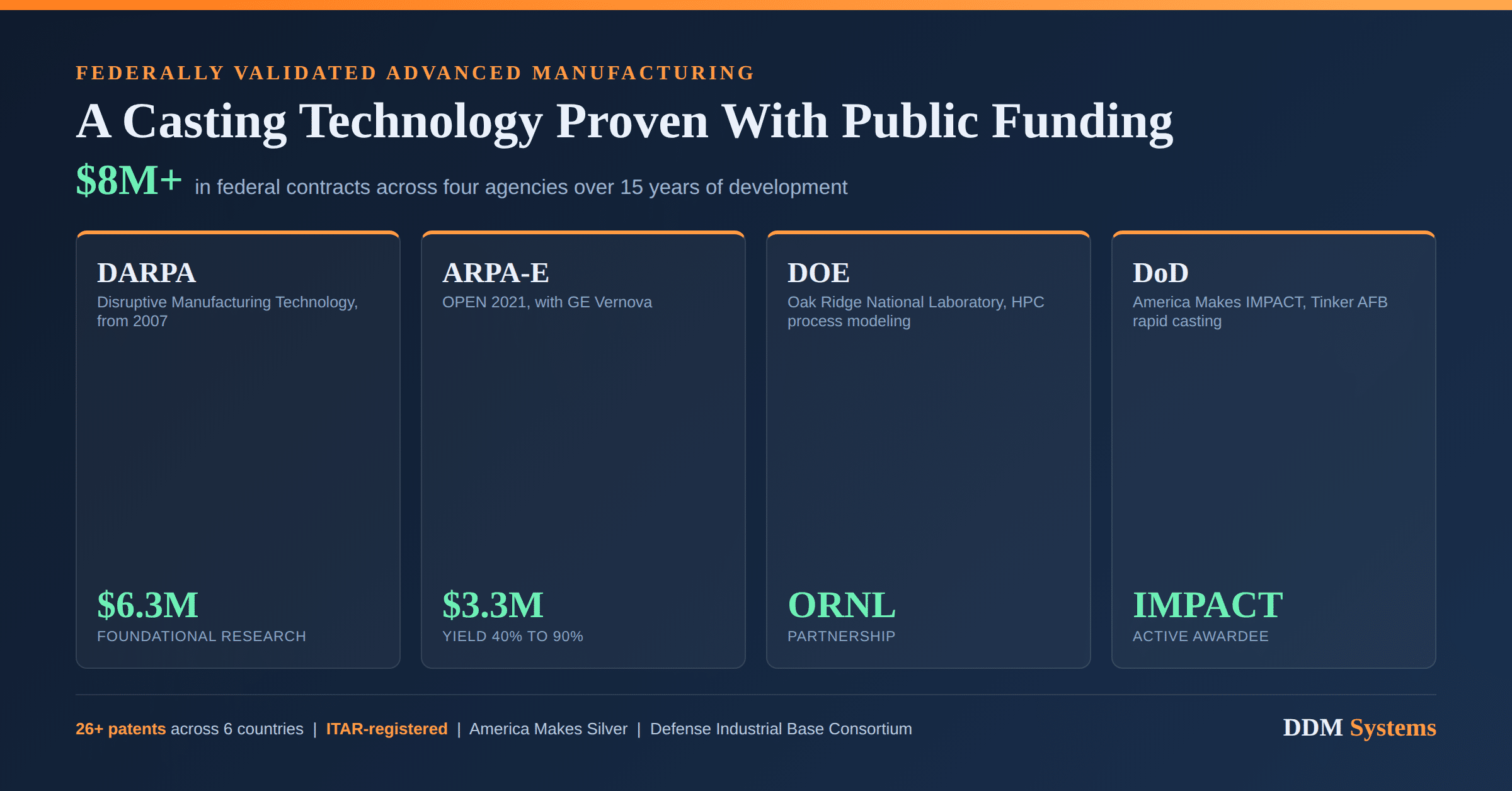
The technology platform grew from federally supported research and industry programs rather than from an untested production concept. DARPA funded the four-year, $6.3 million Direct Digital Manufacturing of Airfoils program led by Honeywell Aerospace, with Georgia Tech researchers led by Suman Das participating in the project.
DDM Systems later received a $3.3 million ARPA-E OPEN 2021 award in collaboration with GE Vernova for high-yield investment casting of gas-turbine components. The program reported a casting-yield improvement from 40% to 90% and energy-use reductions of up to 90% relative to the conventional baseline defined for the project.
Patent records, America Makes project records, federal program documentation and peer-reviewed research supporting the LAMP and SLE technology families are collected on the site’s Technical Evidence and Primary Sources page.
Why the AI power buildout changes the casting equation
AI infrastructure is creating a concentrated need for new power generation on timelines that do not align with conventional turbine-component lead times. The production problem cannot be addressed only by adding turbine assembly capacity: hot-section castings must arrive before those assemblies can be completed.
For turbine OEMs, power developers and component suppliers, the commercial question is therefore not simply whether a ceramic shell can be printed. It is whether digital shell production can be connected to qualified alloy processing, foundry capacity, inspection requirements and repeatable delivery of finished metal parts. DDM Systems built LAMP, DirectPour and SLE as connected parts of that manufacturing path.
Technical resources
Readers evaluating the process can review the detailed pages for 3D-printed ceramic shell molds, LAMP digital investment casting, industrial gas-turbine parts, and casting-grade alloys.
The original announcement was distributed by EIN Presswire on July 28, 2026. This first-party version adds technical context, evidence links and direct routes to the relevant manufacturing capabilities.