
Fluid Handling Manufacturer |
Pump & Valve Casting Solutions
Precision pump and valve castings delivered in days — not months — with zero tooling investment.
Rapid Precision Castings produces high-performance fluid-handling components — including impellers, valve bodies, manifolds, and custom liquid-handling products, using our patented LAMP™ ceramic 3D-printing technology. First parts arrive in as little as 10 days at 50% lower cost, with no dies, patterns, or tooling required. Our investment casting process supports demanding applications in chemical processing, water treatment, beverage systems, industrial fluid handling, and other critical liquid handling equipment.
Benefits of Fluid Handling Manufacturing Solutions
Zero Tooling Investment for Complex Geometries
Traditional fluid handling casting requires $50,000–$200,000+ in dies and multi-piece cores before a single component can be produced. LAMP™ eliminates this barrier entirely:
10x Faster Production Lead Times
Legacy casting processes demand months for tooling design, fabrication, and qualification — downtime that critical fluid systems cannot afford. Digital Foundry™ delivers components in as little as 10 days:
Impossible Internal Flow Geometries
Few casting processes can achieve the closed impeller vanes, branching passages, and curved channels required for optimal hydraulic efficiency. Our LAMP™ process integrates all internal features into a single printed ceramic shell:
Industry Applications
Pump & Impeller Castings
Closed impellers with complex internal vanes represent the most challenging geometries in fluid handling manufacturing. Traditional investment casting cannot produce undercuts or re-entrant features essential for hydraulic performance. Our LAMP™ process integrates all internal vane structures into a single printed ceramic shell:
- Closed impellers with curvilinear vane channels, eliminating 12+ sets of tooling
- Stainless steel 316L, duplex alloys, and corrosion-resistant materials cast with feature resolution down to tens of microns
- Superior flow characteristics and full dimensional compliance with no secondary machining
- Supports a full range of industrial pumps, mixers, and liquid handling systems
Valve Body Components
Traditional valve body casting requires multi-piece tooling that introduces parting lines and compromises accuracy. LAMP™ eliminates this by printing monolithic ceramic shells that capture all internal features — multiple flow paths, pressure regulation chambers, and integrated sealing surfaces — in a single casting operation:
- Ball valve bodies, gate valve housings, and specialty control valves cast in bronze, stainless steel, and exotic alloys
- Internal flow optimization reduces pressure drop and improves control precision
- Cast-in features eliminate secondary machining, reducing lead times, maintenance, and costs
- Supports liquid handling products for chemical processing, water treatment, and industrial sectors
No other domestic foundry delivers this combination of geometric complexity and material capability for fluid handling components.
Industrial Applications Gallery
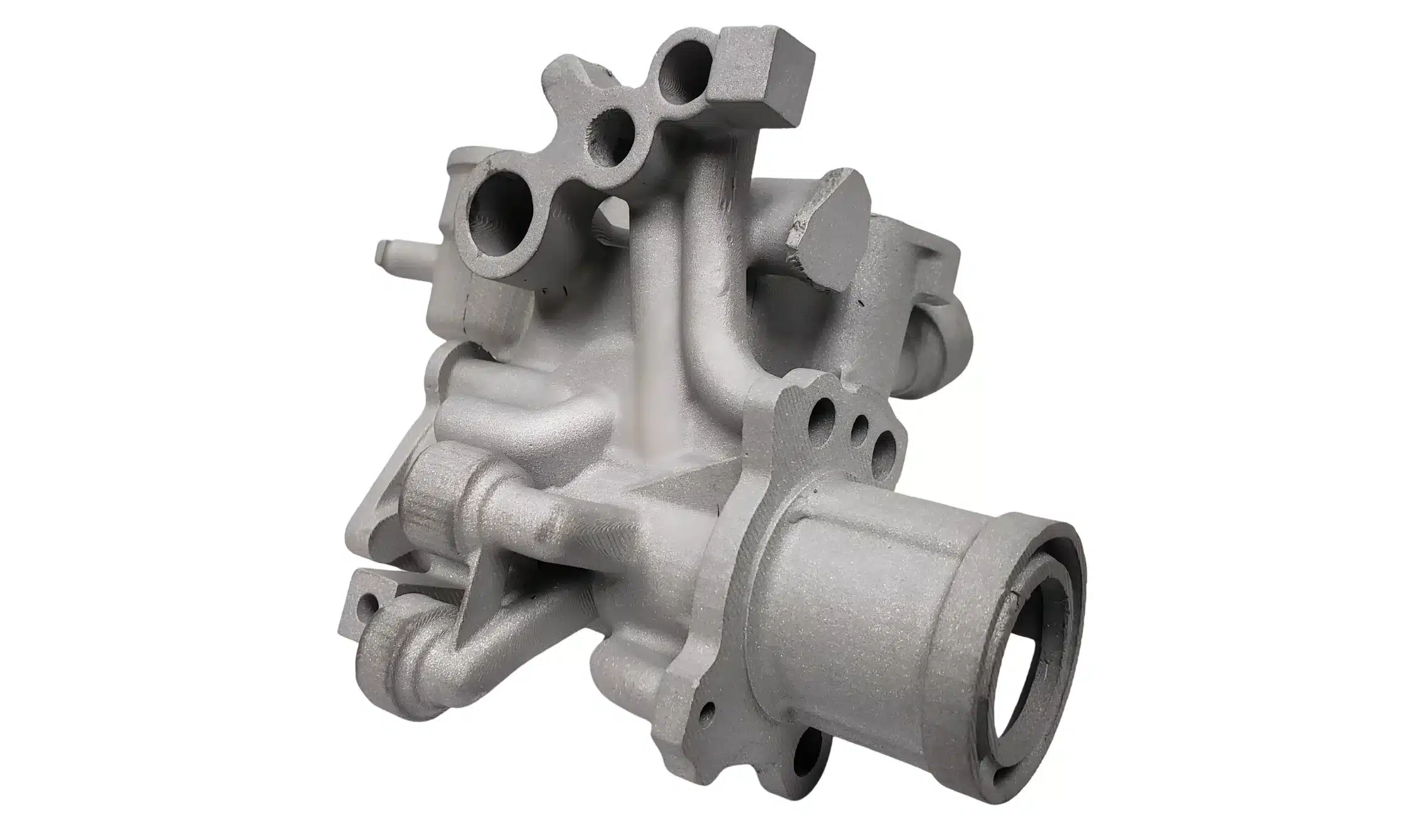
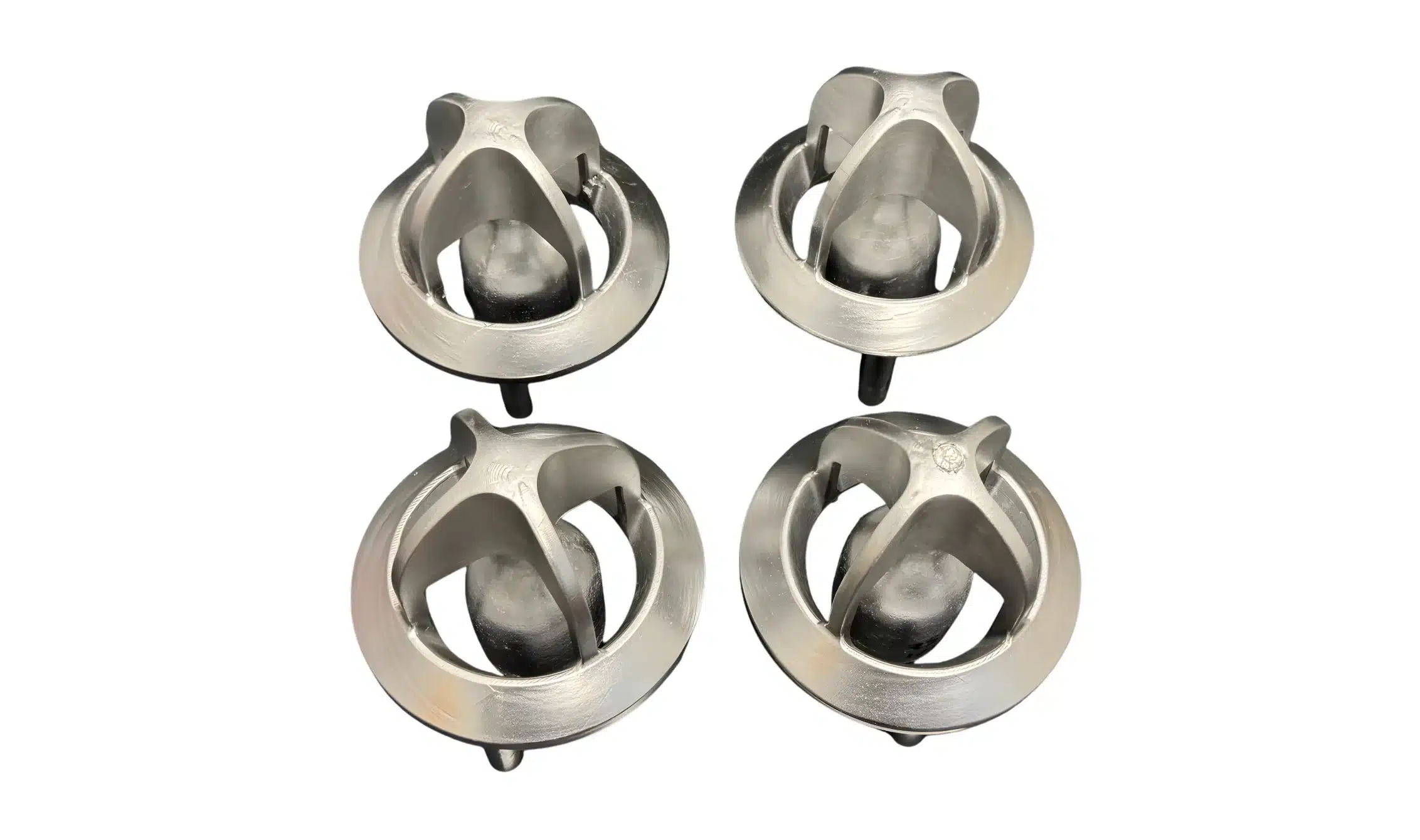
Our Fluid Handling Manufacturing Process

Digital Model Analysis and Flow Optimization

LAMP™ Ceramic Shell 3D Printing
Our proprietary Large Area Maskless Photopolymerization prints monolithic ceramic shells directly from your digital file — no wax patterns, no core assembly, no traditional molds:

Precision Metal Casting and Quality Delivery
Ceramic shells are sintered to over 99.5% density before pouring. We cast a broad range of fluid- handling alloys using air-melt and vacuum-melt processes:
Why Choose Rapid Precision Castings for Fluid Handling Solutions
Proven Fluid Processing Industry Experience
LAMP™ technology has delivered complex fluid handling components across aerospace hydraulics, industrial processing, and high-precision applications:
Technology Leadership and Validation
Complete Domestic Manufacturing
Every fluid handling component remains within a fully domestic supply chain for rapid-response industrial and defense applications:
Our Fluid Handling Manufacturing Services
We serve all major industrial regions in the U.S. from our Atlanta, Georgia, Digital Foundry™:
Southeast: Georgia, Florida, Alabama, Tennessee, South Carolina, North Carolina
Industrial Corridors: Texas, Louisiana, Ohio, Pennsylvania, Michigan, Illinois
Western Manufacturing: California, Arizona, Colorado, Washington, Oregon
Northeast: New York, Massachusetts, Connecticut, New Jersey
Midwest Processing Hubs: Wisconsin, Minnesota, Iowa, Missouri, Kansas
Contact Rapid Precision Castings Today
Frequently Asked Questions About Fluid Handling Manufacturing
Fluid handling components are cast in alloys selected for corrosion resistance and chemical compatibility. Common materials include stainless steels (316L, 17-4 PH, Duplex), nickel alloys (Inconel 625, Monel), and aluminum alloys. Material selection depends on the fluid chemistry, operating temperature, and pressure requirements.
3D-printed ceramic molds enable production of complex internal flow geometries (curved channels, thin-walled vanes, tight radii) that are impossible or extremely expensive to tool using traditional methods. They eliminate tooling entirely, reduce lead times by 10x, and produce molds with higher geometric precision than hand-dipped shells.
Using RPC's DirectPour™ process, fluid handling components can be delivered in as little as 10 days for standard geometries and 4–6 weeks for complex parts. Traditional investment casting with tooling typically requires 52–80 weeks.
Rapid Precision Castings produces precision fluid handling components from its Atlanta, GA facility. RPC's patented LAMP™ technology is particularly suited to the complex internal geometries required in impellers, pump housings, valve bodies, and manifold castings.
Yes. Closed impellers with complex internal vanes are among the most challenging geometries in investment casting. RPC has demonstrated production of closed impellers in Stainless Steel 316L with fully integrated internal vane passages — eliminating the multi-piece core assemblies and complex tooling traditionally required.
Traditional tooling limits fluid handling designs to geometries that can be physically cored and extracted from a mold. 3D-printed ceramic molds have no such limitation — curved passages, re-entrant features, thin walls, and complex channel networks are all produced in a single print. This enables engineers to design for optimal flow performance rather than tooling constraints.
Fluid handling OEMs benefit from RPC's elimination of tooling costs and lead times for new product development. Custom impeller designs, new pump configurations, and prototype validation castings are produced directly from CAD files without tooling investment — enabling rapid iteration and faster time to market.
RPC castings are produced to ASTM standards with full material certification and traceability. Castings can be produced per ASME, ANSI, and customer-specific quality requirements. Non-destructive testing including radiography, pressure testing, and dimensional inspection is available as specified.
Yes. RPC casts fluid handling components in a range of corrosion-resistant alloys including 316L stainless steel, Duplex and Super Duplex stainless steels, Inconel 625, Monel, and Hastelloy variants. Alloy selection is matched to the specific chemical environment to ensure compatibility and service life.
RPC's LAMP™ system has a build volume of 600 × 600 × 600 mm (24" × 24" × 24"). Impellers, valve bodies, pump housings, and manifolds within this size range can be produced as single monolithic castings. For larger assemblies, multi-piece configurations can be designed.